Volunteers for the Latvian army, assigned to the 3rd Batallion and, later, to
the 3rd Jelgava Infantry.
Fought the Bolsheviks from June 28, 1919 until October 21, 1919.
Fough Bermont-Avalov from October 21, 1919 - November 9, 1919.
Nov. 9, 1919 - assigned to the Military College for officer training.
May 20, 1920 - graduates from Military College as a Lieutenant and is assigned
to the 6th Riga Infantry.
June 9, 1920 - August 12, 1920 - fights the Bolsheviks in Latgale.
May 20, 1921 - Transferred to the Aviation Division.
March 1922 - Begins flight training (observer) which he had requested. He is a
member of what was to become the third graduating class.
Nov. 26, 1922 - graduates as a qualified observer and is assigned
to the Naval Aviation Unit at Liepaja. Participates in a number of
routine flight assignments, then is transferred back to the Aviation
Division later in the year.
October 11, 1923 - assigned to duty at the Aviation School.
July 18, 1925 - given command of the Aviation School's mechanic/ground
support training program.
Oct.20, 1923 - Nov.4, 1924 - Kandis completes a series of officer
advanced training courses, graduating with top grades.
Nov.17, 1924 - promoted to the rank of virsleitnant.
April 6, 1925 - makes his first solo flight (in Albatros C.1 #20)
May 16, 1925 - is granted his pilot's certification and promoted to the rank of Captain.
1925-1927 - makes familiarisation flights in a wide variety of different aircraft types.
January 2, 1928 - Named Commander of the long-range Recon Squadron based at Krustpils
June 7 - Dec. 7, 1928 - on temporary assignment to France as a member
of the 3rd Fighter Group where he has the opportunity to fly a number of
french-designed aircraft being used by the French.
1929 - Kandis begins work on establishing an aviation section in the Aizsargi.
January 21, 1930 - Turns over command of the long-range Recon Squadron to Kaneps.
May 25, 1930 - participates in the Aviation Festival at Riga/Spilve.
May 31, 1931 - Participates in the Aviation Festival at Riga/Spilve.
August 2, 1931 - Commander of the Reconnaissance Squadron
Sept. 15 1931 - Nov. 17 1933 - transferred to the Technical Division
of the military as the Aviation representative on their staff.
May 28, 1933 - Participates in the Aviation Festival at Riga/Spilve.
October 1933 - Commander of the 2nd Fighter Squadron
Completes advanced fighter refresher course, as well as the new course
covering night flying operations.
January 2, 1934 - Replaces Blaus as Commander of the 1st Fighter Squadron.
Feb.20, 1934 - Assistant Commander of the Aviation School, then
Commander of the School.
Summer, 1934 - organizes the new, unified Latvian Aero Club.
Sept.9, 1934 - Participates in the Aviation Festival at Riga/Spilve.
In the mid-1930s, the Latvian Aviation Regiment was looking to purchase aircraft from abroad to fill a variety of operational roles.
Kandis was a proponent of the modern, monoplane designs, but there was a general distrust of monoplanes within the Regiment's
leadership and he was overruled - they purchased biplane trainers and fighters.
March 23, 1936 - Promoted to the rank of Lt.Colonel.
As a member of a wide variety of boards and committees, he visits
Poland, Czechoslovakia, France and Belgium regarding aviation affairs.
August 21, 1936 - Participates in the Aviation Festival at Riga/Spilve.
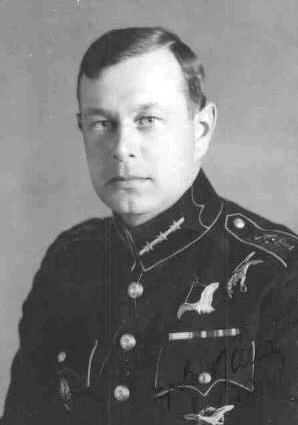
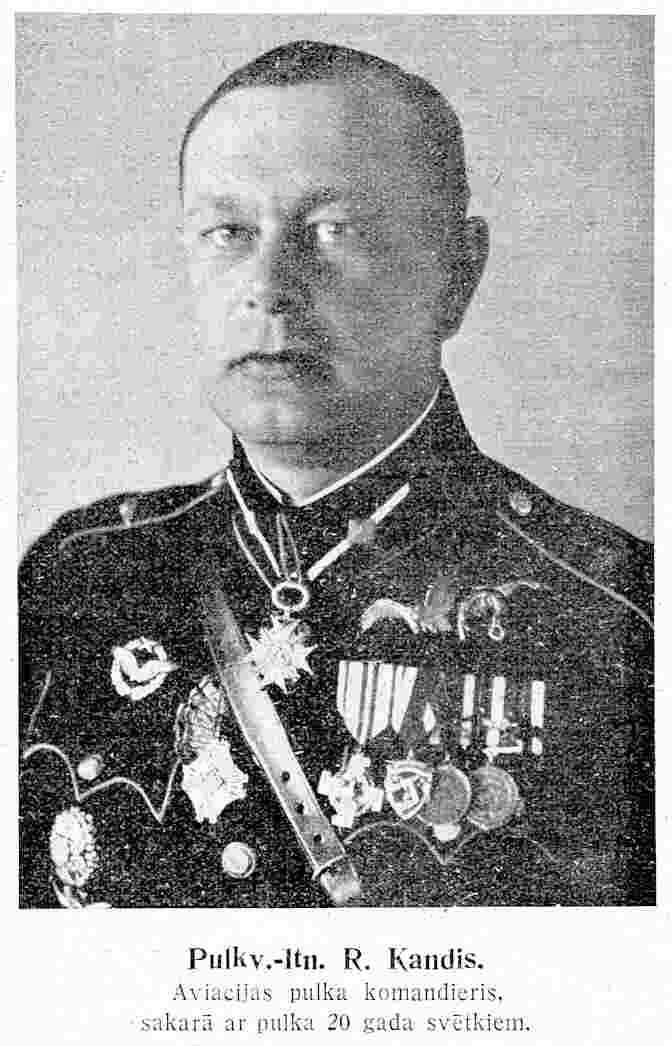
February 10, 1937 - Promoted to the rank of Commander of the Aviation Division,
a position he was to hold until the Soviets occupied Latvia and dissolved the military.
1937 - a report prepared by a British military attache states that the morale in the Aviation Division had been, for the most part,
somewhat poor but that this had markedly improved when R.Kandis was placed in command.
June 9, 1938 - attends at the Daugavpils summer base to ensure that all Fighter Squadron flying personnel (not just the officers) would be
assigned the new Gloster Gladiators.
January 1, 1939 - Kandis speaks to the Aviation Regiment at the NCO club, wishing them a Happy New Year on what was to be
their last year together.
March 28, 1940 - Promoted to the rank of Colonel.
June 17, 1940 - on the day of the Soviet invasion, Kandis appeared at Spilve to direct the aviators. He told them to remain calm,
park the aircraft in the hangars, not to panic and to stay nearby to await further orders. At 11:30 am the Soviet tanks occupied the airfield
and, instead of taking command in an orderly fashion, simply arrested the Duty Officer (S.Milgravis) and his unit of 12 men. Kandis met
with the Soviets and was able to secure their release.
September 1940 - when the aviators selected to serve in the Gulbene Squadron (the aviation section of the Soviet 24th Territorial Corps)
Kandis met the aviators as they departed for Gulbene from Bisumuiza. He addressed them, reflecting on their time serving together and
telling them to continue serving honorably, according to their heart and conscience.
December 1940 - as the last act of dissolving the Latvian Aviation Regiment, Rudolfs Kandis ceremonially burned the Regimental seals in a
bonfire at Bisumuiza. The fate of the Regimental colours is unknown.
Dec.7, 1940 - Under Soviet occupation, he is released from military service.
At the start of the German occupation, Kandis gathered a number of latvian former
military pilots and approached the German military to arrange for a Latvian Squadron.
This first attempt to establish such a squadron was rejected. Such a squadron was created a couple of years later, but
that was after Kandis' death.
July 1941 - Kandis becomes the commander of a 270-man Home Guard unit stationed at Madona.
Feb.27, 1942 the Latvian government of occupation assigns him as
their representative in the Police and Home Defence unit administration for
the Leningrad front. This was under the command of General Gedik, and
Kandis apparently had conflict with another member of the organization,
Colondel Schmidt.
May 28, 1942. R.Kandis is shot to death at the German Headquarters at Leningrad.
Some sort of a confrontation with a German Police Battalion Lieutenant was involved, but the Germans claimed that he
had taken his own life. The truth of the matter is unknown to this day.
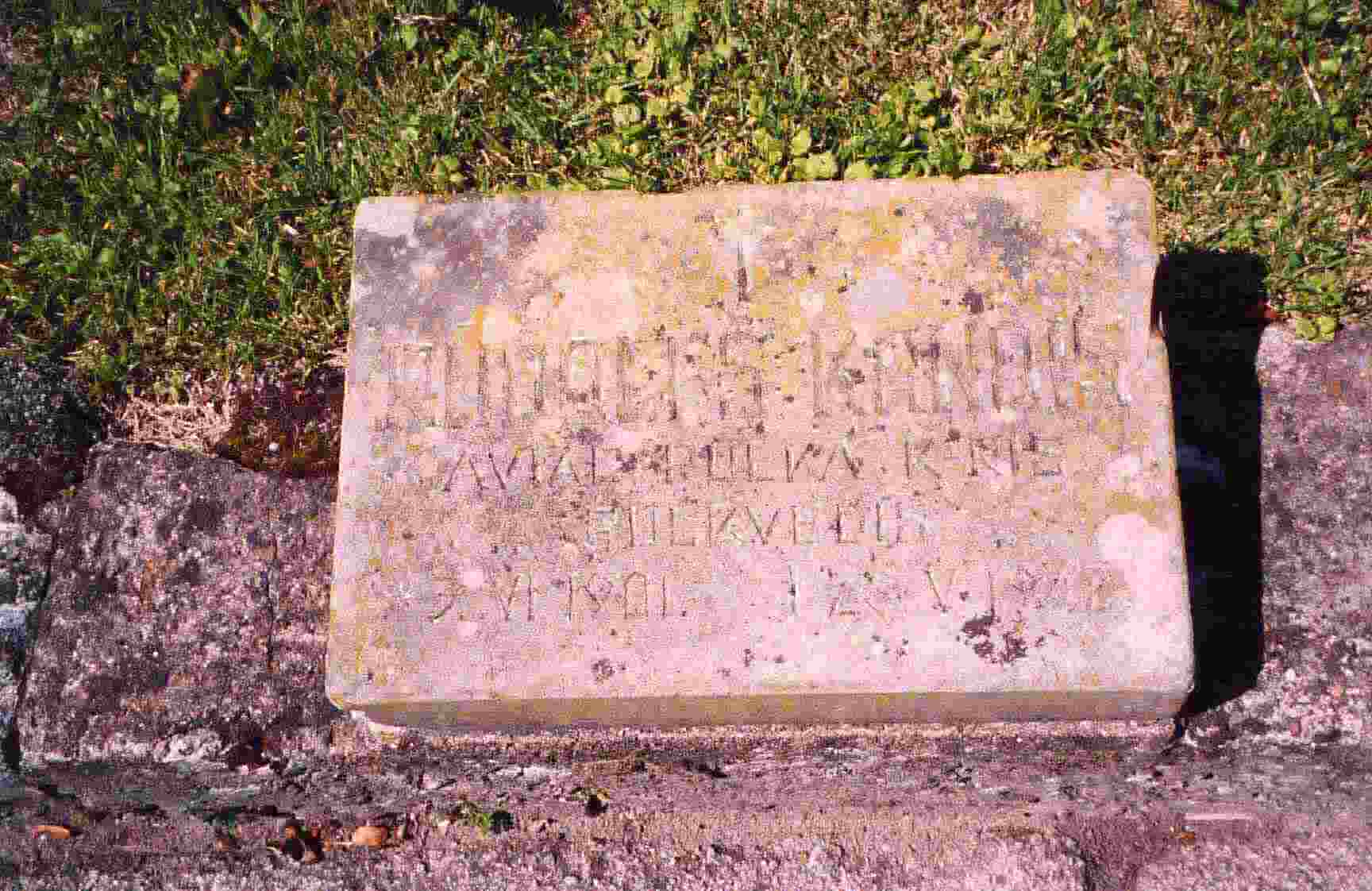
June 1, 1942 - Plkvd R.Kandis is buried with full military honors at
Bralu Kapi cemetary in Riga. During the Soviet occupation, his grave marker
was removed but was replaced on June 30, 1991.
Sources
- Andersons, E. Latvijas Brunotie Speki, pg. 291, 292, 428
- Briedis, Emils Latviesa Stasts
- Bruvelis, Edvins Latvijas Aviacijas Vesture
- Irbitis, Karlis Of Struggle and Flight
- Varpa, Igors Latviesu Karavirs Zem Kaskrusta Karoga
- Daugavas Vanagu Menesraksts, 1969 No.2 pg. 17, 18
- Daugavas Vanagu Menesraksts, 1970 No.3 pg. 17, 18, 19
- Daugavas Vanagu Menesraksts, 1979 No.1 pg. 31, 32
- Daugavas Vanagu Menesraksts, 1982 No.5 pg. 27
- Daugavas Vanagu Menesraksts, 1990 No.5 pg. 26, 29
- Daugavas Vanagu Menesraksts, 1991 No.1 pg. 53
- Latvijas Kareivis, May 22, 1930
- Latvijas Kareivis May 30, 1931
- Latvijas Kareivis June 2, 1931
- Latvijas Kareivis, Sept.5, 1934
- Latvijas Kareivis, Sept.11, 1934
- Sparnota Latvija No. 31, 32, 33, 34, 35, 36, 37, 40, 41, 42, 50, 51, 52, 53, 55,
56, 60, 61, 66, 68, 71
- Bralu Kapi and Tannersville cemetary photos courtesy of B.Rouse
![R.Kandis' marker at Tannersville Evergreen Cemetary, Tannersville, New York [B.Rouse photo]](Images/BB Kandis4.jpg)