WHAT: Finnish Aviator Demonstrates Junkers A.50 in Riga
WHEN: March 17, 1930
DETAILS
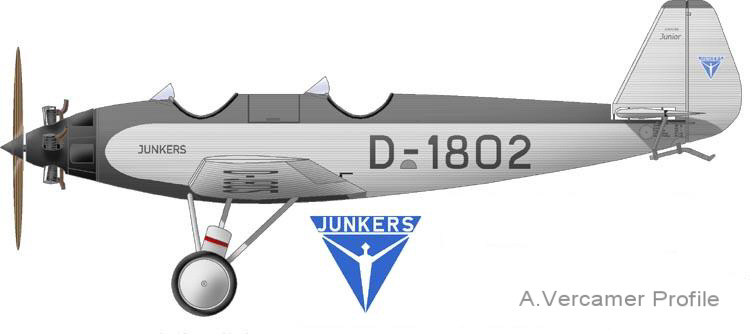
On March 17, a Finnish aviator arrived in Riga (Spilve), flying a Junkers Junior A.50 with the german civilian registration D-1802.
The pilot, airline captain Ville Leppänen was one of the most prominent pre-war aviators of the Finnish national airline Aero Oy.
He and his passenger, Mr.Souchon, were on a promotional journey through the Baltics and Finland, demonstrating the airplanes' flight
characteristics and hoping to take some orders for purchase.
They had left Desau on March 11, and were flying to Helsinki with stops planned for Berlin, Koenigsburg, Kaunas, Riga and Tallinn along
the way. Poor weather interfered with the Berlin stop, but they did reach Spilve on the 17th of March.
The Junkers A.50 (also known as the Junkers Junior) is a two-seat sport aircraft, also suitable as a trainer or military
communications aircraft. It was capable of achieving a maximum speed of 170 km/hr.and was built in the
unique style employed by Junkers at the time, with corrugated metal fuselage.
This particular aircraft (Wr/n 3514) was a JU A50ce, powered by an 80-hp "Genet" engine and registered
in March 1930, the owner being Junkers AG. The latvian press at the time reported that this
aircraft had been purchased by the Suojeluskunta (Finnish National Guard) but, in truth, the Finns acquired its sister craft,
Wr/n 3576, which eventually received the civil registration OH-SKY. The "SK" in the code refers to Suojeluskunta and when,
in 1936, it was handed over to the Finnish Air Force, it retained the SK with its new code "SK-1".
The following day, March 18, D-1802 was demonstrated at Spilve. Unfortunately, ground fog and low clouds limited
the demonstration to a couple of maximum and minimum-speed fly-bys and some barrel rolls. Afterwards, latvian pilot V.Eglitis
had the opportunity to fly the aircraft as well.
The Junkers departed from Spilve/Riga on March 20, heading towards Tallinn, Estonia. The plane encountered very stiff
headwinds, had to make a brief emergency landing at Tõstamaa, but arrived safely in Tallinn at 1745 (though with a practically empty gas tank).
On March 22 they continued their journey with an uneventful 23-minute flight from Tallinn to Santahamina/Helsinki.
SOURCES
- Latvijas Kareivis, March 18, 1930 (Latvian military newspaper)
- Latvijas Kareivis, March 19, 1930
- Latvijas Kareivis, March 23, 1930
- Päewaleht, March, 1930 (Estonian newspaper)
- Uusi Suomi, 23 March 1930 (Finnish newspaper)
- Research contributions courtesy of Carl-Fredrik Geust, Toomas Tyrk and Arvo Vercamer
- Profile courtesy of Arvo Vercamer