WHAT: British Aviators make Goodwill Visit to Latvia
WHEN: September 18 - 20, 1930
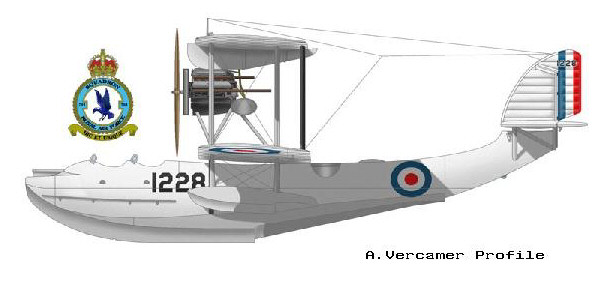
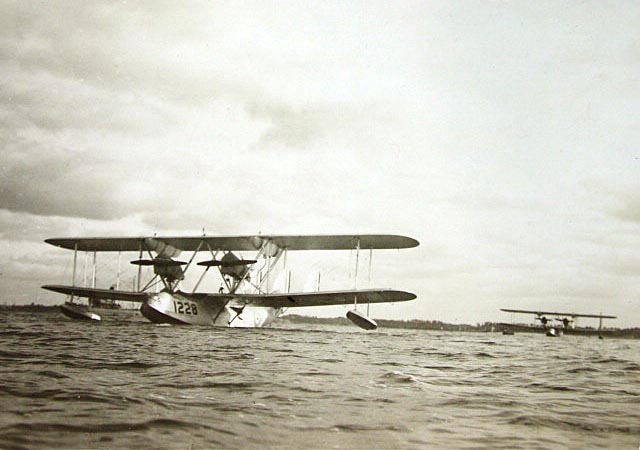
WHO: Three flying boats of 201 Squadron
DETAILS
On September 8, 1930 four Southampton flying boats departed from their home base in Felixstowe, England
and began a goodwill tour of the Baltic and Scandinavia, expected to total over 5000 km. Their route is to be as
follows: Felixstowe - Copenhagen - Helsinki - Tallin - Riga - Memel - Gdansk - Stockholm - Geteborg - Oslo - Felixstowe.
The Supermarine Southampton flying boats each have a crew of five. They are powered by two 480-hp Lyon
air-cooled engines and are capable of a maximum speed of 174 km/hr. They have a range of 1250 km. Ordinarily,
they would be armed with three machine guns and each would carry a 450 kg bomb.
The aircraft were piloted by Capt.Turner (Squadron Commander), Colonel E.Nanson, Group Captain Gossage,
Ltn.Stevens and Ltn.Rogg. This was a very experienced group, members of which had served in India, Iraq, Egypt,
Malaysia and Malta.
Ten days later, in the afternoon of Sept.18, they are scheduled to arrive at Lake Kisezers, just outside Riga.
There, the naval aviation section had built suitable mooring points with buoys, specifically for this
occasion. At 1 pm two Latvian floatplanes, led by Lt.Col Jakubov, departed to meet the British aircraft as they
approached the city and escort them to their destination. An hour later, three British aircraft appeared with their
two Latvian escorts. One Southampton had been delayed when it had turned back to Tallin because of a
misfiring engine. This was quickly repaired and the fourth aircraft arrived just minutes after the first three.
Once the flying boats were safely moored, their crews were taken by motor launch to the nearby yacht club,
where they were met by British ambassador Hodgeson, Major Cox, Aviation Regiment Commander Colonel Skurbe,
Colonel Kikuls, Captain Fitinhof and a great many other officers and officials.
On September 19 the Army Commander General Penikis, General Bangerskis and Admiral Keizerlings
met at Kisezers, where the British fliers displayed their aircraft and explained their technical features. Afterwardsm
they took Generals Penikis and Bangerskis on a flight over Riga and Daugavgriva. Both reported that they were
especially impressed by the aircraft's stability and general flight characteristics.
On the morning of September 20 the British aircraft continued on their tour. They were escorted to the
Lithuanian border by two Latvian naval aircraft.
On September 22 the Latvian ambassador to England received a note of thanks from the British government
for the warm reception their aviators had received in Riga, and particularly for the special construction of the
heavy mooring stations for their flying boats.
SOURCES
- Latvijas Kareivis, September 9, 1930
- Latvijas Kareivis, September 13, 1930
- Latvijas Kareivis, September 16, 1930
- Latvijas Kareivis, September 18, 1930
- Latvijas Kareivis, September 19, 1930
- Latvijas Kareivis, September 20, 1930
- Latvijas Kareivis, September 21, 1930
- Latvijas Kareivis, September 23, 1930